Impact Assessment & Sustainability Reporting
Service > Full-spectrum analysis
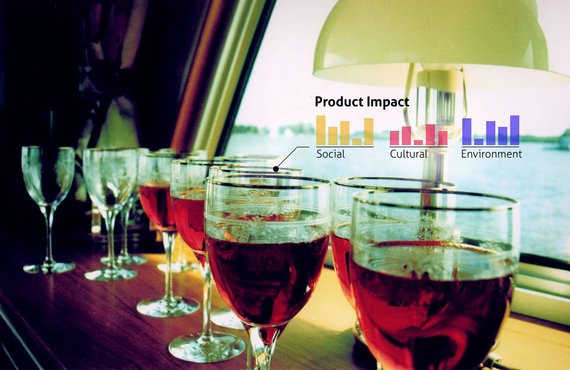
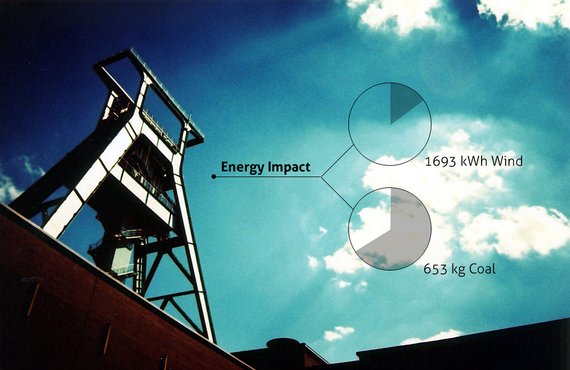
How sustainable is your organization? What are the effects of a new policy, or the impact of a product? How can we improve them?
These are central questions we are faced with today. Sustainability is a complex and dynamic issue, for which we develop effective ways to bring clarity and accuracy to the process. While sustainability methods change rapidly, our fundamental approach creates a long lasting, clear and actionable result.
Applications
 For business
Gain an advantage by knowing how sustainability impacts the strategy of your organization, and how smart assessment helps steer quick decisionmaking.
How do the impacts of your services and products impact stakeholders, and how can you influence this process?
For cities & communities
What are the most effective points of improvement for your neighborhood or building?
What are effective sustainability strategies for urban development? How can you improve the community while advancing the physical appearance and performance of your city?
For industry
The world of stuff is changing: closed loops, supply chain interactions, new technologies, restrictions on facilities and new market opportunities.
Where can you intervene to improve your performance and prepare for future changes?
For policy
What effects do policy decisions have when they ripple through society? What sustainability standards should be introduced in different areas of society?
Do they improve the physical performance of society, or unexpectedly cause the adverse effects? Where can policy have the biggest positive impact?
Range and Stakeholders
Except's sustainability assessments stand out by their wide range, efficiency and insight, customized to your particular situation. We include stakeholders wherever we can, and include our clients in every step of the process.
Physical impacts
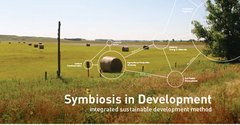
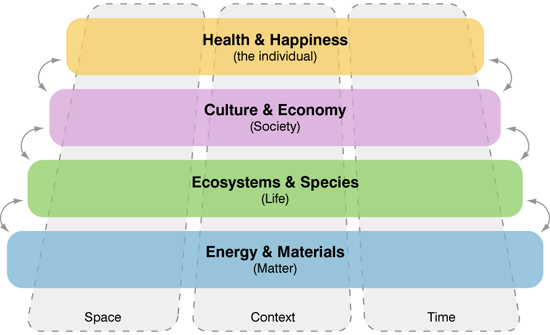
Except's custom developed Symbiosis in Development (SiD) methodology works on all layers of society, and assures a complete and thorough sustainability assessment. For physical parameters it uses the ELSIA index, shown below.
SiD evaluates these aspects for both short and long term effects, as well as global versus local impacts. This include matters of climate adaptation, social justice, CO2, circular economies, transport, biodiversity and cultural value.
Network impacts
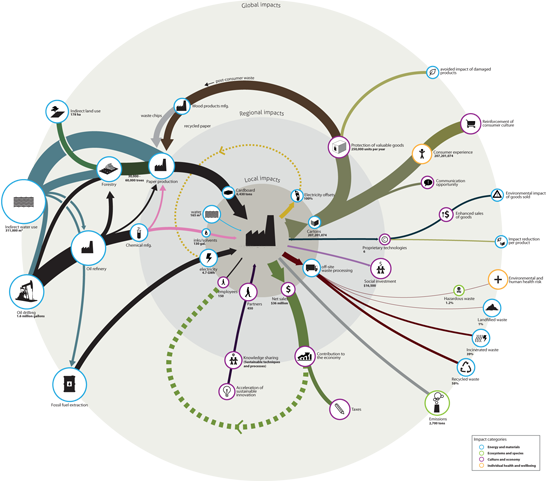
SiD further analyzes sustainability in terms of network impacts, such as resilience, autonomy and transparency. These bring clarity in strategic decision making.
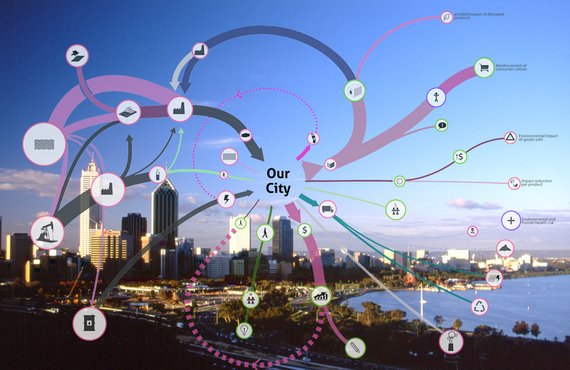
We make use of System mapping to achieve this, which delivers clear visuals about complex delivery chains, societal impacts and system effects.
Tailored solutions
Besides evaluating sustainability in a wide variety of applications, we often develop custom sustainability measurement tools for our clients.
These tools enable custom rapid assessment, and the inclusion of sustainability considerations in all parts of an organization's decisionmaking. Examples include:
- Measuring sustainability for building renovation
- Creating tools for material selection
- Measuring sustainability for onshore wind farms
- Visualizing social justice impacts from waste processing
- Creating dynamic material flow analysis software
Contact us to talk about possibilities for tailored sustainability tools.
Additional tools
A sustainability assessment trajectory can include:
- Location & facility audits
- Carbon assessment & Accounting
- Life Cycle Assessment (LCA)
- Indicator Development
- Thermal & Energy analysis
- Biodiversity measurements
- Stakeholder and production chain analysis
Contact us for more information about these tools.
Examples
Greenprint Book
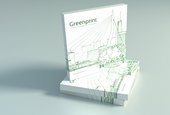
Greenprint features over 150 pages of innovations in our homes, cities and daily life. From eco-houses and neighborhoods to streetlamps activated by moonlight, social innovations, urban agriculture and much more. Greenprint shows how sustainability can change your world from the smallest to the biggest scale.
Yale Carbon Calculator
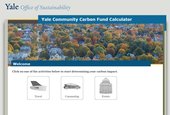
Except worked with Yale University to develop a customized online carbon calculator for the Yale Community Carbon Fund. The calculator allows anyone to calculate their footprint and directly support projects that offset this carbon.
The calculator is an intuitive and easy to use website for calculating greenhouse gas emissions from Yale events and operations:
- Travel and transportation
- Facility use
- Waste generation
- Education
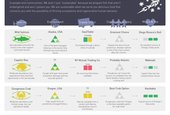
Miya's Sushi Fish Menu
Miya's Sushi in New Haven, CT, has been our favorite restaurant for years, and for good reason. Miya's is a home away from home that produces award winning fusion sushi that places heaven on your tongue, while being the forefront of social and environmental sustainability.
To aid in this, we produced a menu with graphic maps of the unique fish selection of Miya's for internal and external use.
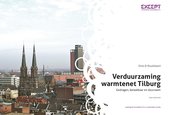
District heating vision Tilburg
This project researches a sustainable district heating system in the Dutch city of Tilburg, developed with our consortium partners.
The vision includes both ecological and social sustainability, and functions as the starting point for all parties involved to cooperate toward a sustainable and carbon neutral heat provision.
No Time To Waste (2018)
LC Packaging serves customers across the globe with packaging products to protect, preserve and transport goods. Except was requested to assess its baseline sustainability performance.
At product level we examined reusing Flexible Intermediate Bulk Containers (FIBCs) and found a significant CO2 emission reduction potential. At corporate level we investigated energy and water use, waste generation and CO2 emission. See below for our main findings.


Contact
Tom Bosschaert
Director
 [javascript protected email address]
 +31 10 7370215